On the morning of December 1st 1948 the body of a man was discovered on Somerton Park beach, about seven miles out of Adelaide. When police arrived at the scene they found the deceased laying in the sand, head propped against the sea wall with his legs outstretched and feet crossed. It seemed almost as though he were sleeping. There was an unlit cigarette resting on the right hand collar of his coat and his pockets revealed an unused train ticket, a bus ticket, aluminium comb, chewing gum, pack of cigarettes and a box of matches. The labels in his clothes had been removed, he had no hat with him (unusual for 1948), was clean shaven and carried no wallet or ID. This led police to believe that he had taken his own life.
Several witnesses came forward to say that they had seen a man who resembled the corpse laying in the same spot on the evening of November 30th, one couple claimed to have seen him stretch out his arm before dropping it to the ground limply. Another couple who had seen him a little later claimed that they had not seen him move but had been sure his position had changed. The second witness also mentioned how they’d found it strange that he had not been reacting to the mosquitos but presumed he was drunk. There was also a statement from a woman who said she had seen another man looking down at him from the top of the steps that led down to the beach.
The autopsy revealed no outside injury but from studying the internal organs the pathologist believed that the man had ingested poison, he could not say wether this was by his own hand or not, nor could he identify the substance. Because the cause of death and the identity of the deceased could not be determined the coroner was unable to reach any definite conclusion and the police had the body embalmed on December 10th 1948.
On January 14th 1949 a suitcase was discovered at Adelaide railway station which was determined to have probably belonged to the man, the staff informed the police that it had been checked in on November 30th at some time after 11.30am. All identification tags on the clothing items had been removed apart from three, one in a tie, a laundry bag and a singlet. They showed the name T. Keane. After a search revealed that no T. Keane was missing from any English speaking country, police concluded that either the tags had been left as they did not reveal the man’s true name or they had simply been missed but were secondhand.
At the inquest held on June 17th 1949 the coroner was not able to produce any new evidence that pointed towards the identity of the man or how he died. He stated that if it were not for the witnesses who said they were sure it was him they had seen laying in the sand, and moving, he would be inclined to believe that the man had died elsewhere and been moved once he had passed away. This was due to the cleanliness of the deceased’s shoes and that there was no sign of vomiting, a common side effect of poison.
Right around the time of the inquest one more clue revealed itself, a small piece of rolled up paper was found sewn inside the man’s trouser pocket, it had two words printed on it ‘Tamam Shud’. Public library officials identified it as a piece of the last page of the book Rubaiyat of Omar Khayyam and the phrase translated to ‘ended’ or ‘finished’. A nation wide search was conducted to try to find the exact book the page had come from which was, miraculously, successful. Not long after the search began a man handed it in to police, his name was protected at the time and that continues to this day.

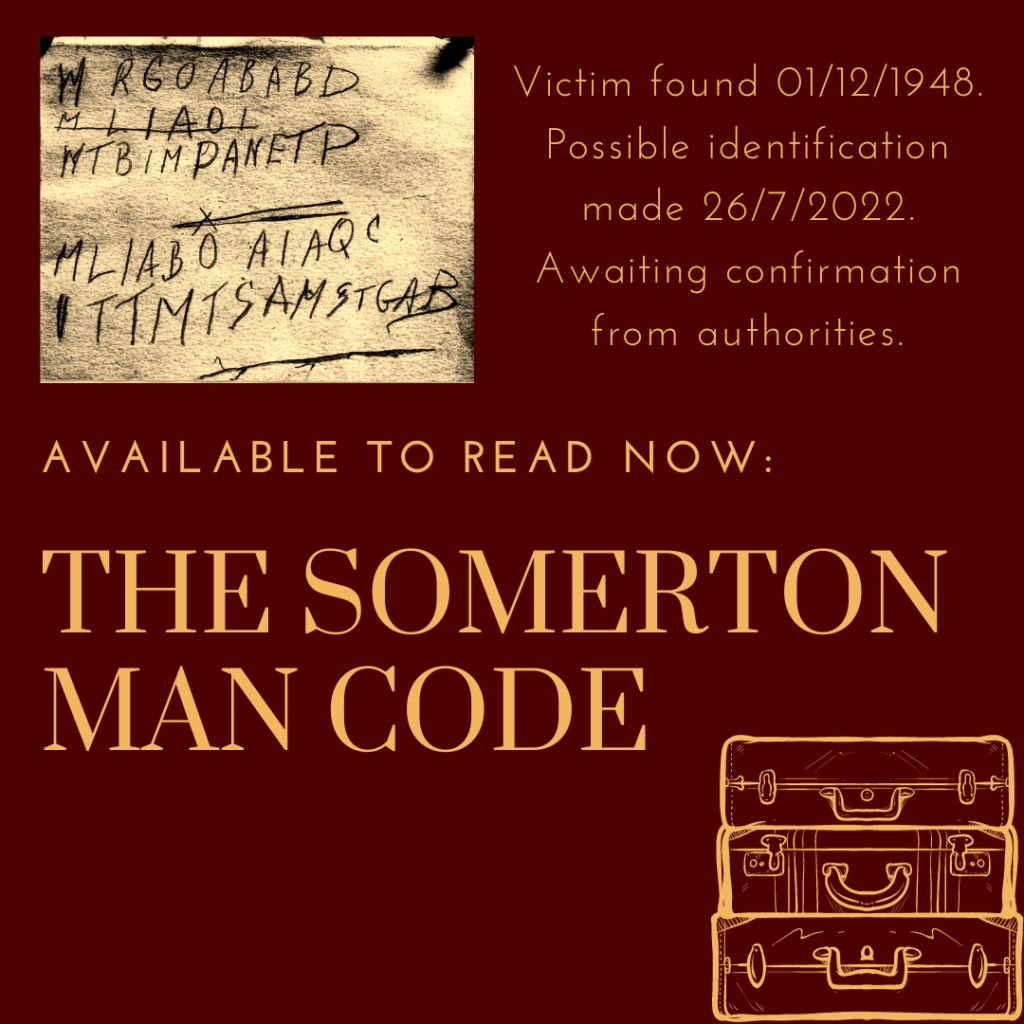
In the back of the book there were faint indentations representing five lines of text, these were carefully identified and copied, revealing what was believed to be some kind of encryption. The investigators noted that the second line had been struck out but it was very similar to the the fourth line, perhaps pointing to a mistake in the code. There was also a phone number of a nurse named Jessica Thomson who, when contacted, said she did not know the dead man or be able to think of a reason for him having her telephone number. However, she did mention that her neighbours had spoken to an unknown gentleman who had tried to call on her in late 1948. When shown the plaster cast of the dead man’s face she once again denied knowing him but the Detective present described her reaction as ‘completely taken aback, to the point of giving the appearance that she was about to faint’. Many believe she knew the identity of the Somerton Man but Jessica would never reveal it if she did.
As for the code, many have studied it including both amateurs and experts. It seems to have been concluded that it may be shorthand rather than an encryption which, if true, means that probably the only person who can read it is the one who wrote it. But that isn’t stopping people from trying to finally solve the Somerton Man mystery and crack his code.
Case Update –
On July 26th 2022, Professor Derek Abbott announced that he and genealogist Colleen Fitzpatrick had determined that the Somerton Man was in fact Carl “Charles” Webb, an electrical engineer who was born on November 16th, 1905, in Footscray, a suburb of Melbourne. Abbott claimed that his DNA identification resulted from strands of hair found in the plaster death mask made by South Australian Police in the late 1940s. Through investigative genetic genealogy (how the Lady of the Dunes was also identified), matches were found for descendants of two distant cousins of Webb, both on the paternal and on the maternal side.
None of Carl’s still-living relatives in 2022 had known him in person and initially there were no known pre-death photographs of him. However, further investigation uncovered his likely presence in a 1921 Swinburne University football team photograph, though the image did not identify Webb directly, and in November 2022 ‘Australian Story‘ revealed photographs of him from the 1920s that were found in a Webb family photo album. Earlier ‘ABC’ had published photos of Carl’s brother, Roy Webb, claiming they resembled the Somerton Man.
Forensic Science South Australia, who are still investigating, declined to comment on Abbott’s findings. South Australia Police have not verified the results, but stated they were “cautiously optimistic that this may provide a breakthrough”.
side note – many people theorise that the nurse, Jessica, was in fact Carl’s wife Dorothy who had filed for divorce and left for South Australia. If this man really is Carl Webb, perhaps he went to find his ex-wife, whether this was for a reconciliation or maybe to ask for help we will never know.

In October 1872, Captain Benjamin Briggs was busy preparing for his maiden voyage on board the newly refitted…
Keep reading
Christine Ida Collins
When her son, Walter, failed to return home on March 10th, 1928, after taking a trip to the…
Keep reading
Ta-sekhet-ma’at, translating to ‘The Great Field’, is known to us today as the Valley of the Kings. Here,…
Keep readingSomething went wrong. Please refresh the page and/or try again.

Proudly powered by WordPress
 Two Queens True Crime
Leave a comment