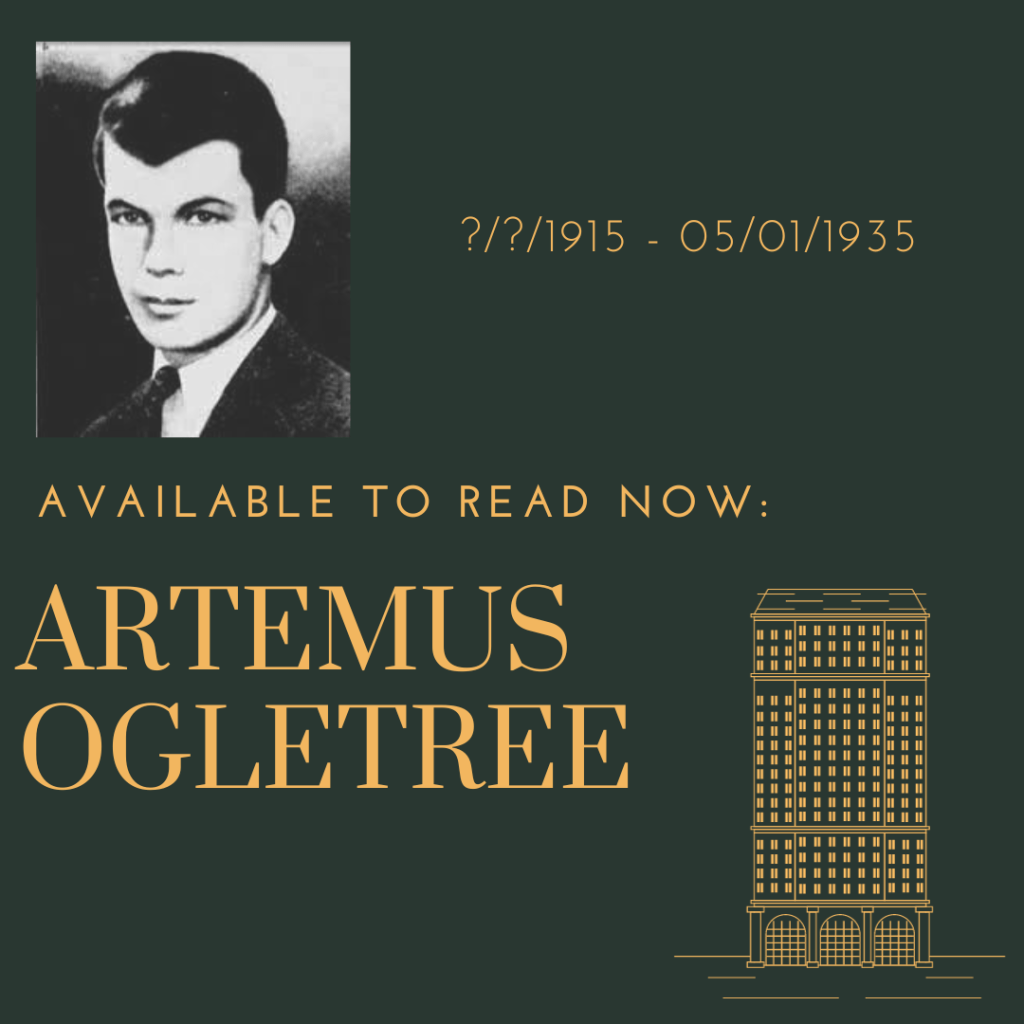
Early in the afternoon of January 2nd 1935, a man checks into the Hotel Presidential of Kansas City under the name of Roland T Owen. He is dressed well and sporting a dark coloured overcoat, however the staff note that he has no bags with him. They also can’t fail to miss the quite visible scar across his temple and a cauliflower ear.

After paying for one night’s stay Mr Owen is escorted to room 1046 by the bellhop, Randolph Proust. This room overlooks the hotel’s courtyard rather than the street, a request that has been made by Mr Owen himself. Randolph watches as the latest guest of the hotel takes a hairbrush, comb and toothbrush from his overcoat pocket (the extent of his unpacking) before they both leave the room together. The bellhop hands over the key to the other man and sees him leave the hotel’s lobby a little while afterwards.
A short time later, Mary Soptic, one of the hotel’s maids lets herself into room 1046 to clean. She is surprised to find a male guest there as the previous day a woman had been staying in the room. Mary apologises and goes to leave but he says she can go ahead and clean the room. Whilst going about her duties she notes that the blinds are drawn and only one small lamp dimly lights the room. (Mary and other members of staff would later say that this was how they always found the room during Mr Owen’s stay).
When Mary returns at 4pm with fresh towels she spots a note on the lamp table that reads ‘Don, I will be back in fifteen minutes. Wait’. Then, on the morning of January 3rd Mary is once again cleaning Mr Owen’s room when the phone rings. Hearing only one side of the conversation, she recalls these words spoken by Owen; ‘No Don, I don’t want to eat. I am not hungry. I just had breakfast. No, I am not hungry’. The last time Mary visits room 1046 is later the same day, in order to deliver more towels as she knows there are none in the room after she took them that morning. Hearing two male voices she knocks on the door and one of the men, upon hearing her intention to leave fresh towels, says ‘we don’t need any’.
At 7am the next morning (4th January) the hotel switchboard operator notices that room 1046’s phone is off the hook and has been for quite some time. She sends Randolph, the bellhop, up to the room who knocks on the door several times until a voice replies ‘come in. Turn on the lights’. Despite this no one comes to let him in and the door is locked, so eventually Randolph shouts through the door to put the phone back on the hook and leaves.
Around 8.30am another bellhop, Harold Pike, is dispatched to room 1046 as the phone is still off the hook. The door remains locked but, unlike Randolph, Harold has a pass key so he let’s himself in. Using only the light of the hallway he spots Mr Owen lying on top of the bed naked, and apparently drunk; the bedding around him is slightly darkened. Not wanting to engage with the seemingly inebriated guest, Harold picks up the fallen phone stand and replaces the receiver before leaving.
At 10.30am the phone is once again taken off the hook but no call is made so Randolph returns, this time taking a pass key. When his knocks aren’t answered he lets himself in and immediately discovers Mr Owen on the floor on his knees and elbows. He has also been bound at his neck, wrists and ankles, and showing signs of attempted strangulation plus suffering multiple stab wounds to his chest.
Although Mr Owen is still conscious when the Doctor and authorities arrive he gives no clue as to what has happened to him, stating that he had fallen and hit his head on the bathtub. Soon after this he loses consciousness and by the time he arrives at the hospital he is completely comatose. He sadly dies of his injuries just after midnight on January 5th without ever waking up.
It is quickly discovered that Roland T Owen is an alias and a huge effort is made to identify the victim from room 1046. Despite having the unknown man’s fingerprints and the story being picked up by newspapers and radio stations across the country, whoever he is remains frustratingly elusive. Sadly, within just a couple of weeks the investigator’s attention is forced away from Roland T Owen as two more homicides occur in the city. Leads that were followed yielded no results and newspaper coverage dwindled.
Then, on March 3rd 1935, the funeral home where Mr Owen is being kept announces in the paper that he will be buried in the city’s potter field. On that very same day the funeral director receives a phone call from a man asking for the service to be delayed so that money can be sent to cover a proper grave and service. When questioned [by the funeral director] as to why the victim had been killed the mysterious caller explained that he [Owen] had been having an affair with a woman whilst engaged to another. According to this surprise informant, he and the two women set up a meeting at the hotel and exacted their revenge, saying ‘Cheaters usually get what’s coming to them!’, before cutting off the call.
The service was postponed and, on March 23rd, the funeral home did indeed receive an envelope containing $25 [$500 today]. A local florist, who too had spoken to the apparent murderer, also received two envelopes containg $5 each; this was to cover an arrangement of 13 American Beauty roses. Included with the cash was a handwritten note, reading ‘Love Forever – Louise’. The only attendees of the funeral were police detectives, who acted as pallbearers, whilst other’s [police] posed as gravediggers and staked out the site for several days. However, nobody visited the mysterious Mr Owen.
It will be another year and a half before the victim of room 1046 is finally identified. In Birmingham, Alabama a friend of Ruby Ogletree shows her an article about the case along with a picture of the dead man, stating that he looks an awful lot like her son Artemus. Artemus Ogletree had left home in 1934 to hitchhike to California and had not been seen by his Mother since.
Ruby contacts the police and is able to provide enough information that they are convinced Artemus is their man, this includes the description of his scar, caused by a spill of hot grease when he was a child. However, despite now knowing just who their victim is investigators are no closer to an arrest, or even knowing for certain what had happened to poor Artemus.
Ruby also had her own strange tale to tell; in early 1935 a letter had arrived, supposedly from her son, and then a couple more over the next few months. Strangely though, they were typed, which was not a skill her son had, and she [Ruby] felt they read a little different from his usual style. She had also received a rather strange telephone call in August of 1935 from a man who said that Artemus saved his life in a fight and was now living in Cairo, apparently doing very well for himself. She gives the police the name of the caller, a name that has never been made public. The Cairo lead was followed up but if Artemus really had, at some point, made a trip to Egypt it had not been under his own name. Information from Ruby also lead police to another hotel in Kansas City, The St Regis, where Artemus had stayed with another man. Unfortunately, his [Artemus] travelling companion could not be found.
Detectives revisited the case every few years, right up until the 1950’s, ensuring it stayed open, but no new evidence was ever found. The mysterious ‘Don’ was never identified, it could be assumed he was the caller who contacted the funeral home, and possibly Ruby. If the reason for Artemus’s murder was indeed revenge for an affair, and it happened as the caller said, then where were the two women, who were they? Did the police ever look for them? Especially ‘Louise’ who had supposedly paid for the flowers.
Some theorise that ‘Don’ was in fact a Mafia boss, due to the slang often used as their title. Did Artemus get himself involved in something and couldn’t get himself back out of it, was one of the women connected to a Mafia family?
For now, the killer, or killers, of Artemus Ogletree remain hidden but as forensic science and technology progresses we are seeing more and more cold cases being solved. It will, of course, be too late to put any suspects on trial, and too late to help bring Ruby Ogletree any answers but not too late to find justice for Artemus and his surviving relatives.

In October 1872, Captain Benjamin Briggs was busy preparing for his maiden voyage on board the newly refitted…
Keep reading
Christine Ida Collins
When her son, Walter, failed to return home on March 10th, 1928, after taking a trip to the…
Keep reading
Ta-sekhet-ma’at, translating to ‘The Great Field’, is known to us today as the Valley of the Kings. Here,…
Keep readingSomething went wrong. Please refresh the page and/or try again.

Proudly powered by WordPress
 Two Queens True Crime
Leave a comment